

Community innovation
Start with the problem. Build with the community.
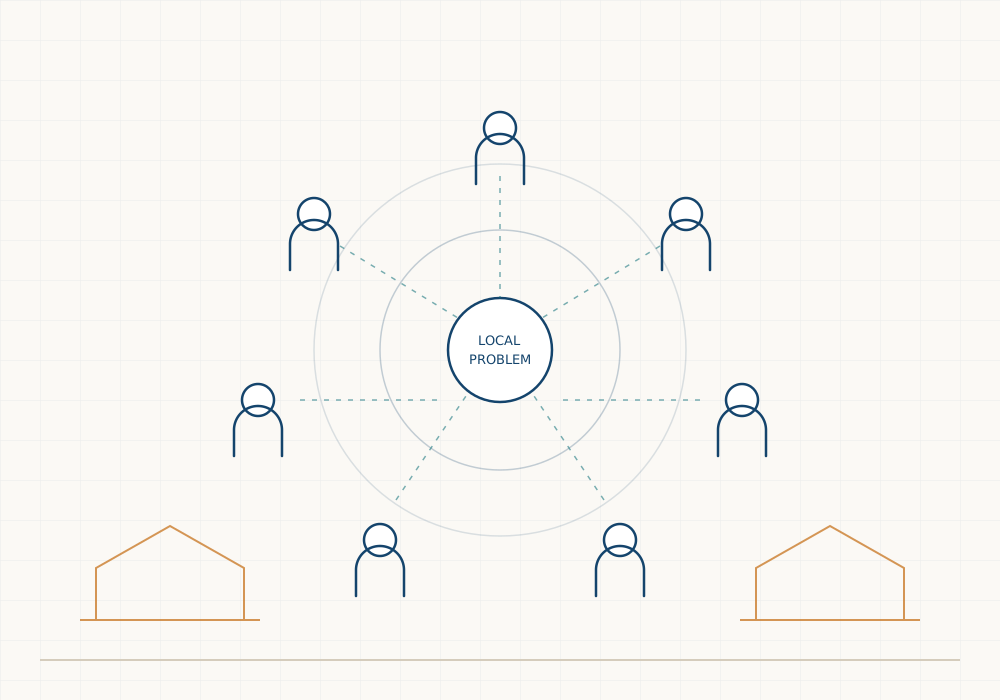
This is what makes ACIC-PUSH an Atal Community Innovation Centre rather than a campus incubator: the work begins where a problem is experienced, not where a founder happens to be standing.
Community outreach
Eight ways the Centre meets a community
Outreach is not a launch event. It is sustained presence, so that the problems the Centre works on are the ones people actually have.
Community consultations
Structured conversations with residents, self-help groups, local bodies and institutions about the problems that matter most to them.
Problem discovery
Field observation and documentation that turns a general complaint into a defined, solvable problem statement.
Innovation awareness
Sessions that show what innovation and entrepreneurship look like in practice for people who have not encountered either.
Village and community engagement
Sustained presence in the communities the Centre serves, rather than one-time visits.
Student–community projects
University students and scholars working on live community problems as part of their academic and innovation work.
Grassroots innovator identification
Finding people who are already solving local problems informally, and connecting them to design, technical and enterprise support.
Local knowledge documentation
Recording existing practices and know-how so that solutions build on what a community already understands.
Community innovation camps
Multi-day camps that bring problem owners, students, mentors and makers into the same room.
Problem discovery
A complaint is not yet a problem statement
Discovery is the work of turning something people put up with into something that can be defined, measured and solved.
- Who exactly is affected, and how many of them are there?
- How often does it happen, and what does it cost them — in money, time or health?
- What do people already do about it, and why is that not enough?
- What has been tried before here, and what happened to it?
- What would count as an improvement, in the community’s own terms?
Grassroots innovators
In most communities somebody has already built a workaround — a modified implement, a repair technique, a way of organising labour. The Centre looks for those people first, because they have already done the hardest part: understood the problem.
- Identification through community partners and field visits
- Documentation of the existing solution and the knowledge behind it
- Design, technical and enterprise support to strengthen it
- Recognition and, where appropriate, IP guidance
Student–community projects
University students and scholars work on live community problems as part of their academic and innovation work — which gives the community capability it could not otherwise buy, and gives students a problem that is not hypothetical.
Design thinking & advanced tinkering
Six steps, repeated until the evidence is good enough
Design thinking is the method the Centre teaches and uses. Advanced tinkering is where the fourth step actually happens.
- 01
Empathise
Spend time with the people affected. Observe, listen, record.
- 02
Define
State the problem precisely enough to be solved and measured.
- 03
Ideate
Generate many options; hold none of them too tightly.
- 04
Prototype
Build the cheapest thing that can be tested honestly.
- 05
Test
Put it in front of real users in real conditions.
- 06
Learn & Iterate
Improve what works, discard what does not, and repeat.
The cycle repeats until the evidence is good enough to build on
Community innovation camps
Everyone who matters to a problem, in one room
Multi-day camps bring problem owners, students, mentors and makers together — so that the person who understands the problem and the person who can build something are not meeting for the first time at a demo day.
Camp schedule
Not yet scheduledCamps will be published on the events calendar with dates, locations, host partners and how to take part. Nothing is listed until it is scheduled and approved.
Community Challenge Portal
A public place to put a problem
Planned for Digital ACIC Phase 2. Communities, institutions and industry partners will publish problem statements; solvers will respond; shortlisted solutions will get prototype support.
- 01Publish community, institutional and industry problem statements
- 02Accept ideas and solution submissions
- 03Enable team formation across disciplines
- 04Route submissions for expert review
- 05Offer prototype support to shortlisted solutions
- 06Create pilot and deployment opportunities
- 07Showcase selected solutions publicly
The portal is not open yet
Until it is, a community problem can be sent to the Centre directly through the idea submission route, and it will be handled by the programme team.
Inclusive innovation
Who the Centre is deliberately trying to reach
Participation by these groups is tracked as an indicator in its own right, not treated as a by-product of general outreach.
Women innovators
Targeted outreach, mentoring and participation tracking across every programme.
Youth innovators
School, college and out-of-college young people entering innovation for the first time.
Rural and community innovators
Innovators working on agriculture, livelihoods, water, waste and local services.
Underserved groups
Participants from communities that existing innovation and enterprise support does not reach.
Social enterprises
Ventures whose primary return is social or environmental rather than financial.
Frugal innovations
Solutions designed for affordability, repairability and local availability of materials.
Local livelihood solutions
Innovations that raise household income or reduce the cost of everyday work.